ORIGINAL ARTICLES
Clinical features of acute febrile thrombocytopaenia among patients attending primary care clinics
Tong Seng Fah MMed(FamMed UKM), Noorazah Abdul Aziz MMed (FamMed UKM), Chin Gek Liew FRCP(Edin),
Khairani Omar MMed(FamMed UKM)
Department of Family Medicine, Universiti Kebangsaan Malaysia (UKM)
Introduction: Identifying clinical features that differentiate acute febrile thrombocytopaenia from acute febrile illness without thrombocytopaenia can help primary care physician to decide whether to order a full blood count (FBC). This is important because thrombocytopaenia in viral fever may signify more serious underlying aetiology like dengue infection.
Objective: The aim of this study was to compare the clinical features of acute febrile patients with thrombocytopaenia and acute febrile patients without thrombocytopaenia.
Methodology: This was a clinic-based cross-sectional study from May to November 2003. Consecutive patients presenting with undifferentiated fever of less than two weeks were selected from the Primary Care Centre of Hospital Universiti Kebangsaan Malaysia and Batu 9 Cheras Health Clinic. Clinical features of these patients were recorded and FBC examination was done for all patients. Thrombocytopaenia was defined as platelet count <150X109/L. The odds ratio of thrombocytopaenia for each presenting symptoms was calculated.
Result: Seventy-three patients participated in this study. Among them, 45.2% had thrombocytopaenia. Myalgia and headache were common among all patients. However, nausea and vomiting occurred significantly more often among patients with thrombocytopaenia than in patients with normal platelet count (OR 2.2, 95% CI 1.1-4.5).
Conclusion: Acute non-specific febrile patients presenting with symptoms of nausea and vomiting may have higher risk of thrombocytopaenia and should be seriously considered for FBC.
Key words: viral infection, dengue, clinical features, thrombocytopaenia.
See also See Commentary by Esha Das Gupta.
INTRODUCTION
Dengue infection is the most common arthropod-borne infection in the tropics where it carries significant morbidity, mortality and immense economic burden to the countries affected.1 The incidence of dengue infection is on the rise in Malaysia.2 Early diagnosis of dengue infection is important in order to minimise mortality.3 Diagnosis of dengue infection is supported if there is thrombocytopaenia, the presence of which often signify more serious type of dengue infection.4-6 All these point to the importance of detecting thrombocytopaenia in suspected dengue patients.
It is difficult to differentiate dengue infection from other viral infections due to the overlap in the symptoms. 7-12 To make the distinction, one may decide to order full blood count (FBC) for all febrile patients. This practice is often impractical due to the large number of febrile patients in the outpatient clinic. Thus, clinical features that suggest the presence of thrombocytopaenia help primary care physician to decide whether full blood count is necessary. The objective of this study is to identify clinical features that differentiate between febrile patients with and without thrombocytopaenia.
METHODS
This was a cross-sectional study conducted at two primary care clinics (Primary Care Centre of Hospital Universiti Kebangsaan Malaysia and Batu 9 Cheras Health Clinic) from May 2003 to November 2003. Consecutive febrile patients who fulfilled study criteria were invited to participate in the study. The inclusion criteria were age ≥12 years with a history of fever for less than 2 weeks. Fever was defined as oral temperature >37.5oC. Patients were excluded if localised source of infection can be identified, e.g. urinary tract infection. Illnesses with pathognomonic clinical features e.g. varicella infection, measles, rubella, scarlet fever and dengue haemorrhagic fever. Consents were taken from all eligible patients before enrolment. Their clinical features were recorded using standard data collection sheet and FBC examination was done for all patients. The investigators were blinded to the FBC result until all clinical features were recorded. In this study, patients with thrombocytopaenia (defined as platelet count <150X109/L) were managed as dengue infection until the availability of their dengue IgG and IgM status.13 Patients with normal platelet count were called back on day 5 of illness for a repeat clinical assessment and FBC examination in order not to miss any dengue infection.
The data collection sheet also asked for demographic data of patient, days of fever, presenting symptoms (headache, myalgia, nausea and vomiting, arthralgia, retro-orbital pain and rash) and FBC results.
We analysed the data using SPSS version 11. For non-categorical and normally distributed data, Student’s t-test was used. For categorical data, c2 tests were used and odds ratios were calculated accordingly for each of the presenting symptom. Significant level of difference was defined as p<0.05. Calculated minimal sample size of 61 patients (using Epi-Info 2000) was required for in this study based on the estimated prevalence of dengue infection of 20% (95% confidence interval; worst estimated of 10%) among patients presented with acute non-specific febrile illness.
We obtained ethical approval from the Research and Ethics Committee of Medical Research Center UKM.
RESULTS
One hundred fifty-three patients were screened, 49 did not give consent for the study and 17 were excluded for not fulfilling the criteria. Fourteen patients defaulted follow up as they claimed to be well and refused reassessment. Therefore, only 73 patients were included in the study. Among them, 33 patients (45.2%) had thrombocytopaenia. Mean age of the patients in this study was 27.3 years (range 12-65, SD±11.1). The majority of the patients were male (67.6%) and 73% were Malays, followed by Chinese (12.2%) and Indians (9.5%). There was no significant gender and ethnicity difference between patients with thrombocytopaenia and patients with normal platelet count (Table 1).
Table 1: Baseline characteristics of patients with and without thrombocytopaenia
| Demographic characteristics | Platelet countNormal |
Thrombocytopaenia |
| Mean age, years | 29.1 | 25.1 |
| Sex | ||
Male |
29 (72.5) | 20 (60.6) |
| Female | 11 (27.5) | 13 (39.4) |
| Ethnicity | ||
Malay |
31 (77.5) |
22 (66.7) |
| Non-Malay | 9 (22.5) | 11 (33.3) |
All comparisons statistically not significant (p>0.05
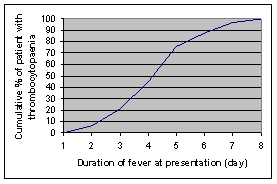
Patients presented to the clinic at different days of fever. These ranged from 2-10 days of fever (mean days of fever 4.7±1.7). Patients with thrombocytopaenia had a mean duration of fever at presentation of 4.7 (± S.D 1.5) days; while those with normal platelet count had a mean duration of 4.0 (± S.D 1.9) days. Most patients (94%) with thrombocytopaenia presented on or at least by day 3 of fever (Figure 1). If duration of fever ≥3 days at presentation was taken as a variable to determine the odds of having thrombocytopaenia against patients with normal platelet count, the OR was 5.9 (95% CI 1.2-28.8) which was statistically significant.
Figure 1. Cumulative rate of thrombocytopaenia by duration of fever among patients with thrombocytopaenia
Common symptoms reported among patients with thrombocytopaenia were myalgia (69.7%), headache (66.7%), nausea/vomiting (69.7%) and arthralgia (39.4%). When the clinical features presented by the 2 groups were compared, only nausea/vomiting were significantly different (OR 2.81; 95% CI 1.1-7.4); other clinical features did not show any significant difference (Table 2).
Table 2: Comparison of the presenting symptoms among patients with and without thrombocytopaenia
| Symptom | Platelet count Normal |
Thrombocytopaenia | OR^ (95% CI) |
| Presented at or after day 3 of fever | 26 (65%) | 31 (93.9%) | 5.88 (1.20-28.8)* |
| Myalgia | 32 (80) | 23 (69.7) | 0.58 (0.20-1.68) |
| Headache | 25 (64.1) | 22 (66.7) | 1.20 (0.46-3.16) |
| Nausea/vomiting | 18 (46.2) | 23 (69.7) | 2.81 (1.07-7.41)# |
| Arthralgia | 26 (40) | 13 (39.4) | 0.98 (0.38-2.50) |
| Retro-orbital pain | 9 (23.1) | 6 (18.2) | 0.77 (0.24-2.43) |
| Rash | 5 (12.5) | 8 (24.2) | 2.24 (0.66-7.67) |
^Odds ratio (95% confidence interval), *p=0.04, #p=0.03
DISCUSSION
Generally the symptoms of patients with thrombocytopaenia and patients with normal platelet count were similar except for nausea and vomiting. Nausea and vomiting was found to be significantly different between these two groups of patients. The odds of thrombocytopaenia among patients with complaints of nausea and vomiting were about twice. Could it be postulated that the pathological response resulting in thrombocytopaenia may also give rise to the symptoms of nausea and vomiting? Whatever the explanation might be, the importance of detecting thrombocytopaenia cannot be over emphasised. Hence we should consider a FBC test among patients presenting with symptoms of nausea and vomiting as the odds of developing thrombocytopaenia is high and they might be at risk of severe disease which require admission.
Another important aspect to look at is the association of duration of fever and the presence of thrombocytopaenia. Although there was no difference in the mean duration of fever among patients with thrombocytopaenia and normal platelet count, there were 5 times the odds of thrombocytopaenia if patients presented at day 3 of fever compared to those presented on day 1 or 2 of fever. This is not unexpected, as dengue patients usually develop thrombocytopaenia at day five to seven of illness when the fever starts to subside.5,14 The mechanism for such occurrence is due to increases peripheral platelet destruction and marrow suppression.14 Hence, it is advisable that all patients presenting on day 3 of fever should be offered a FBC test. On the other hand, doing a full blood count in a patients presenting early (i.e. day 1 or 2 of illness) may not be appropriate as the rate of picking up a thrombocytopaenia is low.
In this study, the data was collected prospectively in order to standardise the data collection and to minimise incomplete data. All selected patients selected had acute non-specific febrile illness from the outpatient setting. This was an important feature of this study as the studies in the past mainly recruited patients from hospital or suspected cases of dengue from outpatient setting, who might not represent the typical patients with acute non-specific febrile illness. Furthermore, previous studies had not looked into the association of clinical features and thrombocytopaenia among patients presented with acute non-specific febrile illness. Presence of thrombocytopaenia helps clinicians in assessing the severity of the illness;4-6 therefore it is critical for health care professionals to be able to detect thrombocytopenia among patients with acute non-specific febrile illness. Misdiagnosing a case of dengue infection without thrombocytopaenia may not be as disastrous as misdiagnosing a case of dengue infection with thrombocytopaenia, because dengue infection with normal platelet count represents a milder form of DF and do not require admission.
Conclusion
patients with nausea and vomiting should be referred for FBC in view of the higher possibility of thrombocytopaenia. This is important because clinical diagnosis of dengue infection is unreliable. Adopting this approach in managing patients with non-specific acute febrile illness can guide health care professionals to be more selective in requesting a full blood count.
ACKNOWLEDGEMENTS
We are grateful to Dr. Leelavathi, Dr. Hazizi, Dr. Aida, Dr. Wasilah, Dr. Nor Azila, M/A Azhar and Fairul for their help with data collection. I would like to thank all the laboratory assistants from Batu 9 Health Clinic and Primary Care Clinic Hospital Universiti Kebangsaan Malaysia Bandar Tasik Selatan, for performing the laboratory tests.
REFERENCES
- World Health Organisation. Dengue in the WHO Western Pacific Region. Weekly Epidemiological Record. 1998;73(36):273-80 [Link] [Full text]
- Ministry of Health Malaysia. Health Management Information System. Unit of Information and Documentation System. Communicable Disease Control Information System; 2002.
- Gibbons GV, Vaughn DW. Dengue: an escalating problem. BMJ. 2002 Jun 29;324(7353):1563-6 [PubMed] [Full text]
- Murgue B, Deparis X, Chungue E, et al. Dengue: an evaluation of dengue severity in French Polynesia based on an analysis of 403 laboratory-confirm cases. Trop Med Int Health. 1999 Nov;4(11):765-73 [PubMed]
- Srichaikul T, Nimmannitya S. Haematology in dengue and dengue haemorrhagic fever. Baillieres Best Pract Res Clin Haematol. 2000 Jun;13(2):261-76 [PubMed]
- Krishnamurti C, Kalayanarooj S, Cutting MA, et al. Mechanisms of haemorrhage in dengue without circulatory collapse. Am J Trop Med Hyg. 2001 Dec;65(6):840-7 [PubMed] [Full text]
- Hyams KC, Oldfield EC, Scott RM, et al. Evaluation of febrile patients in Port Sudan, Sudan: isolation of dengue virus. Am J Trop Med Hyg. 1986 Jul;35(4):860-5 [PubMed]
- Sharp TW, Wallace MR, Hayes CG, et al. Dengue fever in US troops during Operation Restore Hope, Somalia, 1992-1993. Am J Trop Med Hyg. 1995 Jul;53(1):89-94. [PubMed]
- Kalayanarooj S, Vaughn DW, Nimmannitya S, et al. Early clinical and laboratory indicators of acute dengue infection. J Infect Dis. 1997 Aug;176(2):313-21 [PubMed]
- Trofa AF, Defraites RF, Smoak BL, et al. Dengue fever in US military personnel in Haiti. JAMA. 1997 May 21;277(19):1546-8 [PubMed]
- Deparis X, Murgue B, Roche C, et al. Changing clinical and biological manifestations of dengue during the dengue-2 epidemic in French Polynesia in 1996/97-descriptive and analysis in a prospective study. Trop Med Int Health. 1998 Nov;3(11):859-65 [PubMed]
- Nunes-Araujo FRF, Ferreira MS, Nishioka SD. Dengue fever in Brazilian adult and children: assessment of clinical finding and their validity for diagnosis. Ann Trop Med Parasitol. 2003 Jun;97(4):415-9. [PubMed]
- World Health Organisation. Dengue Haemorrhagic fever: diagnosis, treatment, prevention and control. 2nd ed. 1997; 67-74 [Link] [Full text]
- Akram DS. Igarashi A. Takasu T. Dengue virus infection among children with undifferentiated fever in Karachi. Indian Journal of Pediatrics. 1998 Sep-Oct;65(5):735-40 [PubMed]