

DOC'S LIFE

A TRIP TO MUKAH
Zainal Fitri Zakaria MMed (FamMed, UKM)
Family Medicine Specialist, Klinik Kesihatan Jalan Lanang
Address for correspondence: Dr Zainal Fitri Zakaria, Klinik Kesihatan Jalan Lanang, 96000 Sibu, Sarawak. Tel: 084-210433, Fax: 084-214133,
Email: drzainal@tm.net.my
Zainal Fitri Z. A trip to Mukah. Malaysian Family Physician. 2006;1(2&3):97-98
Editor’s note: This article is a revised version of an article published in the author’s blog (http://www.drzainal.blogspot.com/).Being posted to Sarawak is the last choice for most Semenanjung doctors; it is the same for me. Working in the Land of the Hornbill has been a great cultural experience. Working as the sole Family Medicine Specialist in the Central Region (Sibu, Mukah , Sarikei and Kapit Divisions) is even more challenging. Covering the Central Region, a land area equivalent to Pahang and Trengganu combined, bring an unexpected benefit – travelling!
Mukah Airport
 My first familiarisation trip took me to Mukah along the Sarawak coast. Instead of toiling on the bumpy 160 km 3-hour road trip from Sibu to Mukah, I opted for the quicker route by air which took only 25 minutes. There is only one flight in and out of Mukah, hence I got the chance to spend a night there.
Flying in the Twin Otter plane is yet another new experience. This is the smallest aircraft in the MAS series which only accommodate 19 persons. The cabin is non-pressurised and has no air-conditioner. However, there are two small fans like what cabbies will sometimes mount on their dashboards. The heat in there during midday is quite unbearable! There is no barrier between the passenger area and the cockpit, so you can see the pilots going through their start-up procedure in the cockpit, flipping switches and pulling levers.
A bird’s-eye view of Mukah town
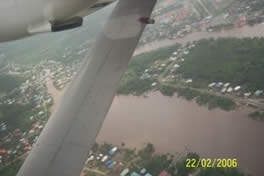 At the height the plane was flying, I could see the Sarawak wilderness spreading out below me, and the vast stretches of peat swamp covering the lowlands. There was a brief moment of nauseating feeling as we hit air turbulence. Soon, the meandering rivers amidst the lush green forest came into view, showing that we were approaching the coast. As we approached Mukah, I could see oil palm plantations, laid out in orderly blocks, with their network of drainage canals and roads. Here and there, I saw patches of land with a different variety of palm trees and narrow, shallow waterways – I later learned those were traditional sago plantations.
Mukah Division was newly declared as the Tenth Division of Sarawak on the 1st March 2002 by the Chief Minister of Sarawak, YAB Datuk Patinggi Tan Sri (Dr) Haji Abdul Taib Mahmud. It is an ancient trading and fishing port, situated at the mouth of the Mukah River as it opens to the South China Sea. Historically, the town was an outpost of the Sultanate of Brunei until the mid 19th century; it became part of Sarawak in 1861. During its heydays, it had direct trades with China, Singapore and the neighbouring areas.
The majority of the Mukah population are Melanau. They are considered by the anthropologists to be among the original settlers of Sarawak. Legend has it that the name "Melanau" was given to the inhabitants of the coastal swamp flats and river banks of Central Sarawak by one of the Sultans of Brunei. The original religion of the Melanau people was Liko, meaning "people of the river". In the Liko religion, life and the environment are one. Followers worship the spiritual world, including the superior tou spirits and the lesser belum spirits that cause sickness. The pagan Melanau used effigies of sickness spirits in healing practices which they called berbayoh and berayun. Many Melanau today are Christians and Muslims, although they still celebrate traditional festivals especially the 'Kaul Festival'.
Melanau people speak a language that is totally different from the local Sarawak dialect. You may be able to make an intelligent guess when people speak in Iban, but you can’t really make out anything sensible if it is Melanau! To complicate things, the Melanau dialects from different regions within the same district can be quite different; hence it is not unusual for a Melanau from Matu to speak to another Melanau from Balingian in Bahasa Melayu Sarawak!
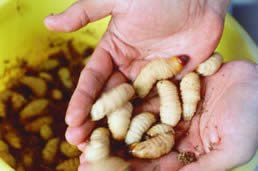
Sago worms – a Sarawakian delicacy
 One of the famous dishes among Melanau is what they called umai. It is small pieces of raw fish, with added lemon juices, and eaten with a special spicy sauce. It is said that umai was first introduced by the Japanese during the occupation era.
My brief visit to Mukah that day was merely to introduce myself to the medical fraternity in Mukah and to make a primary assessment of the outpatient service in Hospital Mukah. Hospital Mukah is an 80-bedded hospital with four medical officers. Besides their regular work in Mukah Hospital, these doctors have to cover two other hospitals in the district that do not have resident doctors, as well as doing the Flying Doctors Service when required. Like other health facilities in the Central Region, the outpatient clinic in Mukah has been equipped with the Tele-primary Care network to facilitate communication and referral via the internet. A short dialogue and discussion with the doctors, medical assistants and nurses gave me an overall picture of the problems and assistance they needed. Concerning the care of the chronic illness, they noted that patient compliance is a big problem.After this short visit to Mukah I went back to Sibu the next day to prepare for the next trip. Below are some photographs I have taken during my trip to Mukah.