

ORIGINAL ARTICLES

Clinical features of acute febrile thrombocytopaenia among patients attending primary care clinics
The data collection sheet also asked for demographic data of patient, days of fever, presenting symptoms (headache, myalgia, nausea and vomiting, arthralgia, retro-orbital pain and rash) and FBC results.
We analysed the data using SPSS version 11. For non-categorical and normally distributed data, Student’s t-test was used. For categorical data, c2 tests were used and odds ratios were calculated accordingly for each of the presenting symptom. Significant level of difference was defined as p<0.05. Calculated minimal sample size of 61 patients (using Epi-Info 2000) was required for in this study based on the estimated prevalence of dengue infection of 20% (95% confidence interval; worst estimated of 10%) among patients presented with acute non-specific febrile illness.
We obtained ethical approval from the Research and Ethics Committee of Medical Research Center UKM.
RESULTS
One hundred fifty-three patients were screened, 49 did not give consent for the study and 17 were excluded for not fulfilling the criteria. Fourteen patients defaulted follow up as they claimed to be well and refused reassessment. Therefore, only 73 patients were included in the study. Among them, 33 patients (45.2%) had thrombocytopaenia. Mean age of the patients in this study was 27.3 years (range 12-65, SD±11.1). The majority of the patients were male (67.6%) and 73% were Malays, followed by Chinese (12.2%) and Indians (9.5%). There was no significant gender and ethnicity difference between patients with thrombocytopaenia and patients with normal platelet count (Table 1).
Table 1: Baseline characteristics of patients with and without thrombocytopaenia
| Demographic characteristics | Platelet countNormal |
Thrombocytopaenia |
| Mean age, years | 29.1 | 25.1 |
| Sex | ||
Male |
29 (72.5) | 20 (60.6) |
| Female | 11 (27.5) | 13 (39.4) |
| Ethnicity | ||
Malay |
31 (77.5) |
22 (66.7) |
| Non-Malay | 9 (22.5) | 11 (33.3) |
All comparisons statistically not significant (p>0.05
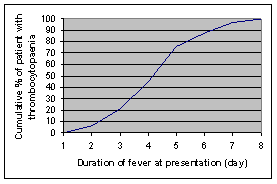
Patients presented to the clinic at different days of fever. These ranged from 2-10 days of fever (mean days of fever 4.7±1.7). Patients with thrombocytopaenia had a mean duration of fever at presentation of 4.7 (± S.D 1.5) days; while those with normal platelet count had a mean duration of 4.0 (± S.D 1.9) days. Most patients (94%) with thrombocytopaenia presented on or at least by day 3 of fever (Figure 1). If duration of fever ≥3 days at presentation was taken as a variable to determine the odds of having thrombocytopaenia against patients with normal platelet count, the OR was 5.9 (95% CI 1.2-28.8) which was statistically significant.
Figure 1. Cumulative rate of thrombocytopaenia by duration of fever among patients with thrombocytopaenia
Common symptoms reported among patients with thrombocytopaenia were myalgia (69.7%), headache (66.7%), nausea/vomiting (69.7%) and arthralgia (39.4%). When the clinical features presented by the 2 groups were compared, only nausea/vomiting were significantly different (OR 2.81; 95% CI 1.1-7.4); other clinical features did not show any significant difference (Table 2).
Table 2: Comparison of the presenting symptoms among patients with and without thrombocytopaenia
| Symptom | Platelet count Normal |
Thrombocytopaenia | OR^ (95% CI) |
| Presented at or after day 3 of fever | 26 (65%) | 31 (93.9%) | 5.88 (1.20-28.8)* |
| Myalgia | 32 (80) | 23 (69.7) | 0.58 (0.20-1.68) |
| Headache | 25 (64.1) | 22 (66.7) | 1.20 (0.46-3.16) |
| Nausea/vomiting | 18 (46.2) | 23 (69.7) | 2.81 (1.07-7.41)# |
| Arthralgia | 26 (40) | 13 (39.4) | 0.98 (0.38-2.50) |
| Retro-orbital pain | 9 (23.1) | 6 (18.2) | 0.77 (0.24-2.43) |
| Rash | 5 (12.5) | 8 (24.2) | 2.24 (0.66-7.67) |
^Odds ratio (95% confidence interval), *p=0.04, #p=0.03
DISCUSSION
Generally the symptoms of patients with thrombocytopaenia and patients with normal platelet count were similar except for nausea and vomiting. Nausea and vomiting was found to be significantly different between these two groups of patients. The odds of thrombocytopaenia among patients with complaints of nausea and vomiting were about twice. Could it be postulated that the pathological response resulting in thrombocytopaenia may also give rise to the symptoms of nausea and vomiting? Whatever the explanation might be, the importance of detecting thrombocytopaenia cannot be over emphasised. Hence we should consider a FBC test among patients presenting with symptoms of nausea and vomiting as the odds of developing thrombocytopaenia is high and they might be at risk of severe disease which require admission.